REQUEST A CONFIGURATION / PPS SERIES
Select the signal and installation you need.
PPS codes below identify inquiry families. The table defines what to review; it does not assign an unverified pressure, temperature or bandwidth rating to a supplied unit.
| Configuration request | Pressure / task | Electrical chain | Installation review | Next step |
|---|---|---|---|---|
| PPS-ICP-113 / PPS-ICP-102Flush dynamic piezoelectric | Dynamic excursion + static baseline, psi / bar / MPa | IEPE voltage; current, bias and headroom by configuration | Clamp/ground isolation, installed response and seal geometryPCB Piezotronics 113B / 102B | Request this family ↘ |
| PPS-PRZ-062 / PPS-PRZ-190Miniature DC + dynamic bridge | Absolute / gauge / differential reference explicitly selected | Bridge mV/V, excitation, gain and output swing | Exact thread pitch, front/reference-side response and mediumKulite XCQ / XTL; Endevco 8510B / 8530C | Request this family ↘ |
DOCUMENTED CONFIGURATION OPTIONS
Start with a specific range and signal interface.
These PPS codes map to the named source arrangements. Source values guide quotation review; acceptance applies to the exact offered assembly.
DYNAMIC / AC SIGNAL
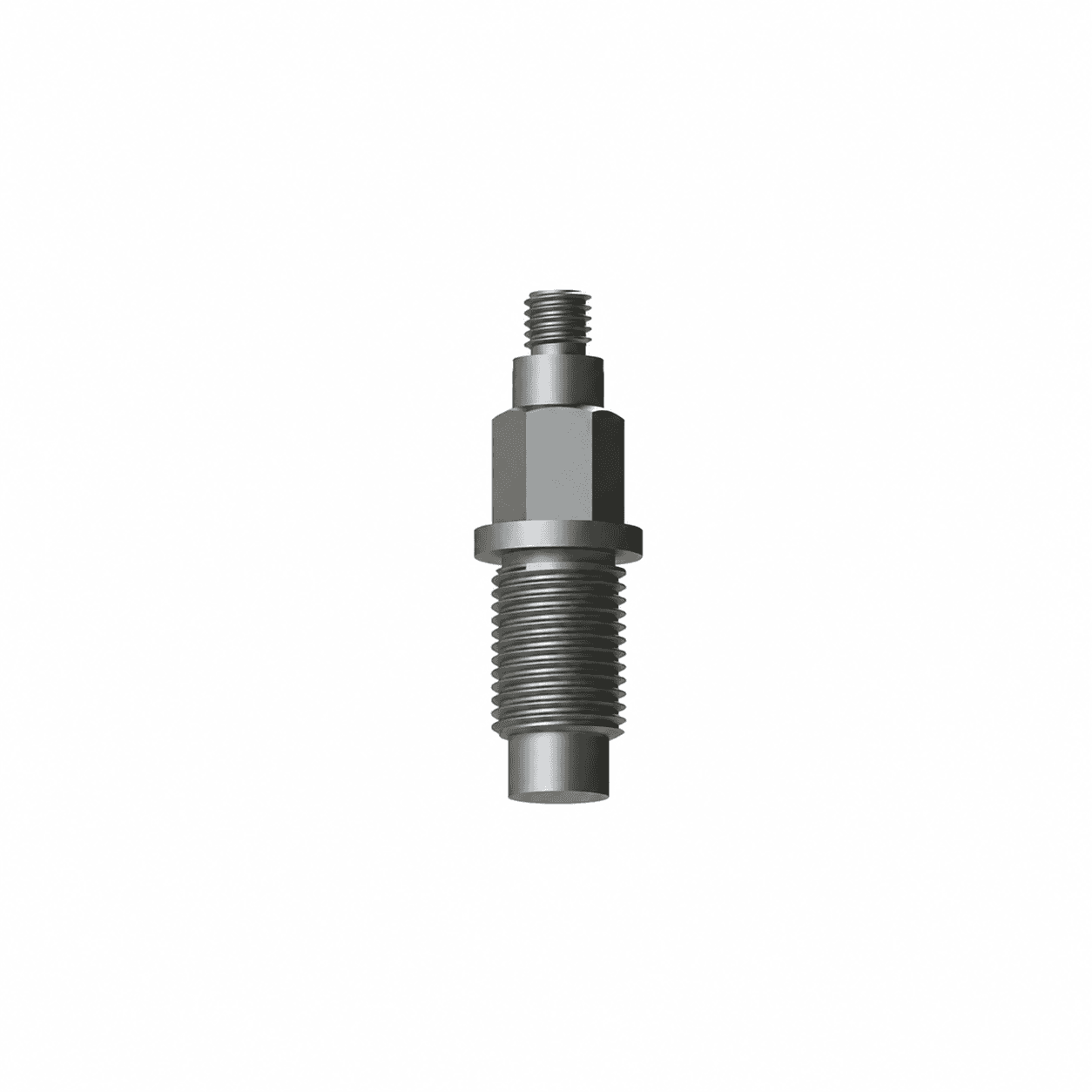
PPS-ICP-F10
Flush IEPE pressure configuration
Dynamic pressure excursion; static preload/reference to confirm
Source-documented configuration · quotation review required
- Output
- IEPE voltage output
- Pressure reference
- Dynamic pressure excursion; static preload/reference to confirm
- Source temperature
- -40 to +120 deg C; exact duty to confirm
- Mount
- M10×1
- Electrical connection
- M5
- Body envelope
- 12.8 x 38 mm; source dimensions, not a port drawing
- Excitation
- 24-28 VDC supply; source table 2-10 mA; cable-drive review required
Source catalogue full-scale options. Reference, static loading, negative phase and exact ordered variant require review.
Review PPS-ICP-F10 dimensions & interfaces ↗Source values & acceptance checks · PPS-ICP-F10
| Full scale | Source sensitivity | Natural / resonant frequency | Catalogue rise time | Variant note |
|---|---|---|---|---|
| 1 MPa / 10 bar / 145.0 psi | 5000 mV/MPa | ≥200 kHz | ≤2 us | high-piezoelectric crystal; composition unspecified |
| 5 MPa / 50 bar / 725.2 psi | 1000 mV/MPa | ≥200 kHz | ≤2 us | high-piezoelectric crystal; composition unspecified |
| 20 MPa / 200 bar / 2900.8 psi | 250 mV/MPa | ≥200 kHz | ≤2 us | quartz |
| 50 MPa / 500 bar / 7251.9 psi | 100 mV/MPa | ≥200 kHz | ≤2 us | quartz |
| 100 MPa / 1000 bar / 14503.8 psi | 50 mV/MPa | ≥200 kHz | ≤2 us | quartz |
Catalogue resonance and rise-time labels are not calibrated flat bandwidth. Rise-time percentage and incident/reflected geometry are not established by this table.
Confirm before a final specification
- Confirm medium/wetted-material compatibility and pressure reference.
- Obtain the approved installation drawing, seal, torque and connector pinout.
- Request the installed amplitude/phase response and calibration scope.
- M10x1 is the pressure mount. The electrical connector is labeled M5 without pitch/pinout; do not infer M5x0.5 or 10-32.
- Source table lists 2-10 mA while long-cable prose suggests over 10 mA; reconcile against the selected electronics before use.
This is catalogue evidence, not a serial-unit calibration certificate, stock confirmation or approved manufacturing drawing.
DC + DYNAMIC BRIDGE
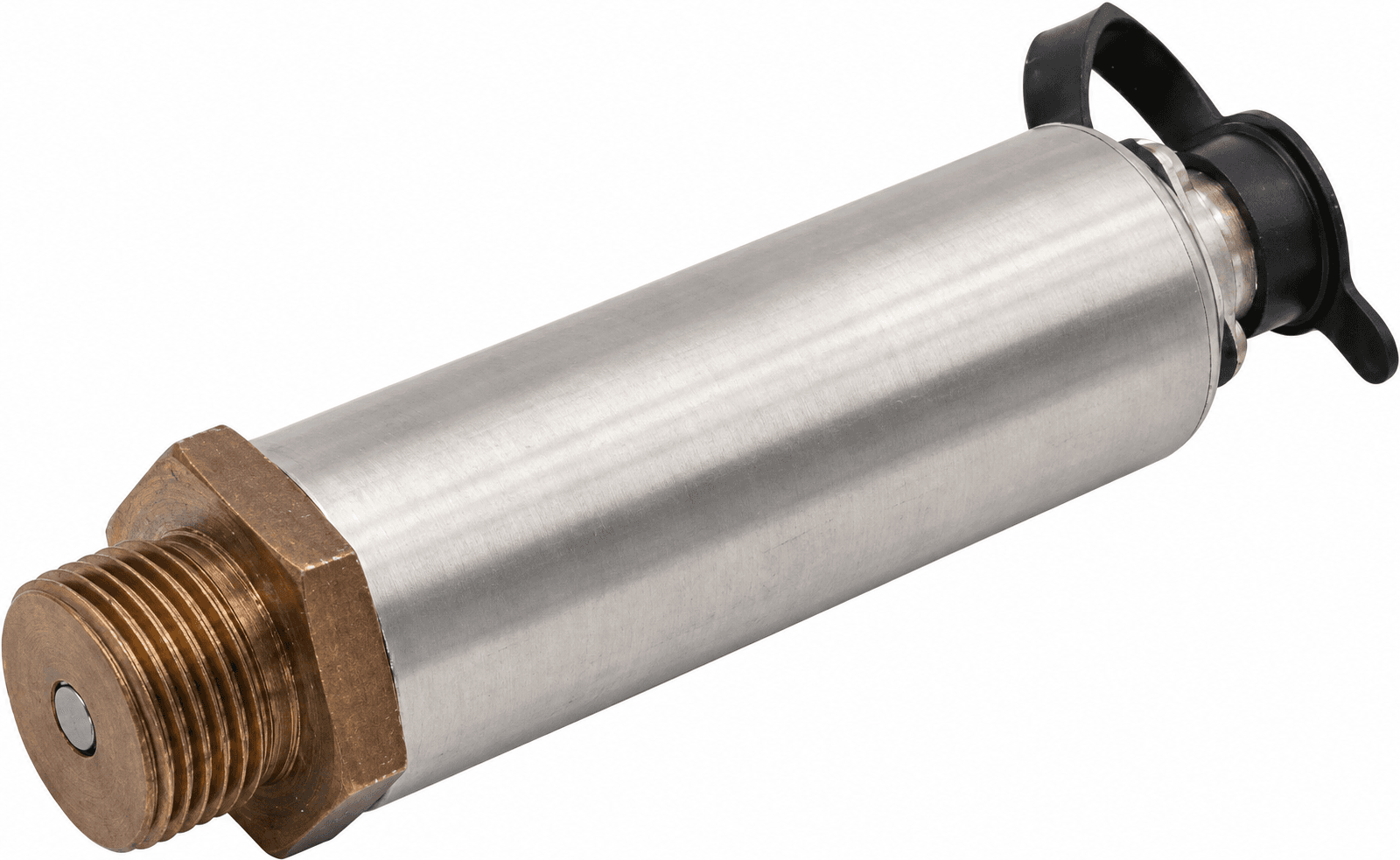
PPS-PRZ-D10
DC + dynamic bridge pressure configuration
Not specified in source table; confirm gauge/absolute/reference
Source-documented configuration · quotation review required
- Output
- Differential millivolts; bridge-compatible conditioning
- Pressure reference
- Not specified in source table; confirm gauge/absolute/reference
- Source temperature
- -40 to +85 deg C or -55 to +125 deg C source options; confirm ordered option
- Excitation
- Source alternatives: 1 or 1.5 mA, or 12 VDC; select exact bridge variant
- Mount
- M20x1.5; source front nose span 12 mm. Usable engagement, seal and exact installation require confirmation.
- Medium
- non-corrosive, nonconductive media compatible with silicon and stainless steel
- Conditioner choices
- Source selection page lists 20/100/200 kHz options; this is not the bare-sensor flat bandwidth
Discrete source full-scale options; sensitivity is not paired by range in the inspected table.
Review PPS-PRZ-D10 dimensions & interfaces ↗Source values & acceptance checks · PPS-PRZ-D10
| Full scale | Source sensitivity | Natural / resonant frequency | Catalogue rise time | Variant note |
|---|---|---|---|---|
| 1 MPa / 10 bar / 145.0 psi | Not range-paired | 180 kHz | 1 us | Source pair; rise-time definition not given |
| 2 MPa / 20 bar / 290.1 psi | Not range-paired | 240 kHz | 1 us | Source pair; rise-time definition not given |
| 4 MPa / 40 bar / 580.2 psi | Not range-paired | 320 kHz | 0.5 us | Source pair; rise-time definition not given |
| 6 MPa / 60 bar / 870.2 psi | Not range-paired | 250 kHz | 0.5 us | Source pair; rise-time definition not given |
| 10 MPa / 100 bar / 1450.4 psi | Not range-paired | 320 kHz | 0.5 us | Source pair; rise-time definition not given |
| 20 MPa / 200 bar / 2900.8 psi | Not range-paired | 450 kHz | 0.3 us | Source pair; rise-time definition not given |
| 40 MPa / 400 bar / 5801.5 psi | Not range-paired | 600 kHz | 0.3 us | Source pair; rise-time definition not given |
| 60 MPa / 600 bar / 8702.3 psi | Not range-paired | 800 kHz | 0.2 us | Source pair; rise-time definition not given |
| 100 MPa / 1000 bar / 14503.8 psi | Not range-paired | 1000 kHz | 0.2 us | Source pair; rise-time definition not given |
Natural frequency is not a flat bandwidth rating. No installed amplitude/phase calibration is established by this catalogue.
Confirm before a final specification
- Confirm exact pressure reference, excitation, sensitivity and pinout for the quoted assembly.
- Request usable installed response and the required calibration deliverables.
- Obtain an approved dimensional/port drawing; catalogue dimensions do not establish a drop-in fit.
- Constant-current bridge excitation is not a two-wire IEPE interface.
This is catalogue evidence, not a serial-unit calibration certificate, stock confirmation or approved manufacturing drawing.
01 / ENGINEERING NOTES
Separate the line pressure from the transient excursion
A hydraulic line can carry a steady pressure and a brief positive or negative excursion. Record both before selecting the sensor range. Pressure reference, measurement range, overload survival and repeated-pulse life answer different questions; a proof-pressure figure is not an operating measurement range.
- State the normal pressure, expected extrema and whether values are gauge, absolute or differential.
- Describe the event: valve closure, pump trip, quick-disconnect or repeated pulsation.
- Include pulse duration, repetition and the required timing or amplitude/phase tolerance.
02 / ENGINEERING NOTES
Choose AC-only pressure or DC plus the event
An IEPE or charge-mode chain can resolve pressure changes when its low-frequency response and pulse droop are acceptable. A suitable DC bridge chain can retain the baseline as well as fluctuations. The choice depends on the record you need, not on the connector shape.
- Long pressure plateaus need a discharge-time-constant review for piezoelectric sensing.
- A bridge output requires compatible excitation, differential gain and enough headroom at the static baseline.
- Media isolation and protective diaphragms may change the installed response.
03 / ENGINEERING NOTES
Put the sensing face at a reviewed pressure port
A recess, narrow passage or flexible connecting tube can introduce resonance and delay. Supply the port drawing and sealing shoulder, gasket thickness, accessible thread depth and allowed protrusion. M5×0.5 and M5×0.8 are different interfaces. NPT engagement alone cannot guarantee an exact sensing-face position.
04 / ENGINEERING NOTES
Match the conditioner to the recorder
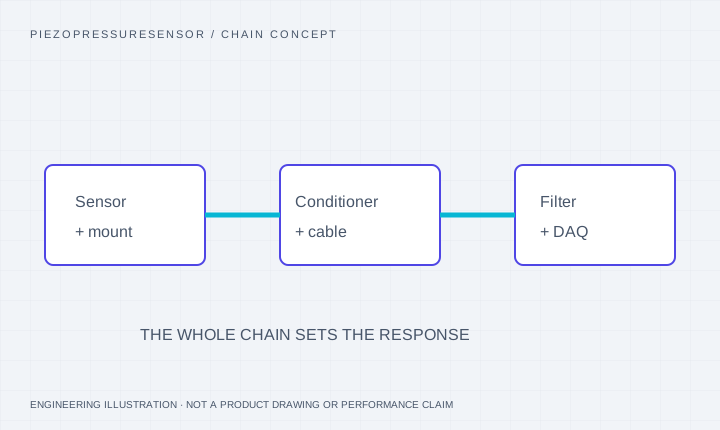
Define the smallest pulse feature and its permissible error. Then review usable sensor response, cable loading, conditioning gain, low-pass filtering and acquisition. A 4–20 mA output format alone does not establish the speed of a process chain.
- For an IEPE chain: current, compliance voltage, bias and cable capacitance.
- For a bridge chain: excitation, output sensitivity, gain and input common-mode limits.
- For the recorder: voltage range, channel synchronization, sampling and anti-alias response.
05 / ENGINEERING NOTES
Prepare a CDU, cooling-loop or hydraulic-rig inquiry
For a liquid-cooling loop include the pressure medium, concentration, temperature, maximum line pressure and connection event. For a hydraulic rig include fluid compatibility, pulse duty and installation space. The RFQ below accepts a private port drawing and requested accessory bundle.
ORIGINAL-MODEL DATA / INDEPENDENT REVIEW
Keep original specifications separate from a proposed replacement.
Facts below describe the named original models. A PPS configuration still needs its own dimensional, electrical and calibration evidence. Resonance and flat bandwidth are different quantities.
| Original model & source | Verified reference facts | Compatibility check | Review request |
|---|---|---|---|
| PCB Piezotronics 113B22 | 5,000 psi / 344.7 bar; 1 mV/psi; resonance ≥500 kHz; rise time ≤1 μs. | The range is for ±5 V output. Resonance is not flat bandwidth. Mounting uses a separate floating clamp nut; electrical 10-32 is not a pressure-port thread. | Review this original ↘ |
| PCB Piezotronics 102B | 5,000 psi / 344.7 bar; 1 mV/psi; 3/8-24 mount; 10-32 electrical connector. | Do not conflate mechanical 3/8-24 mounting with electrical 10-32 connector. M/S suffix variants require their own verification. | Review this original ↘ |
No affiliation or universal interchangeability is implied. Pressure-port threads and electrical connector threads must be checked separately.
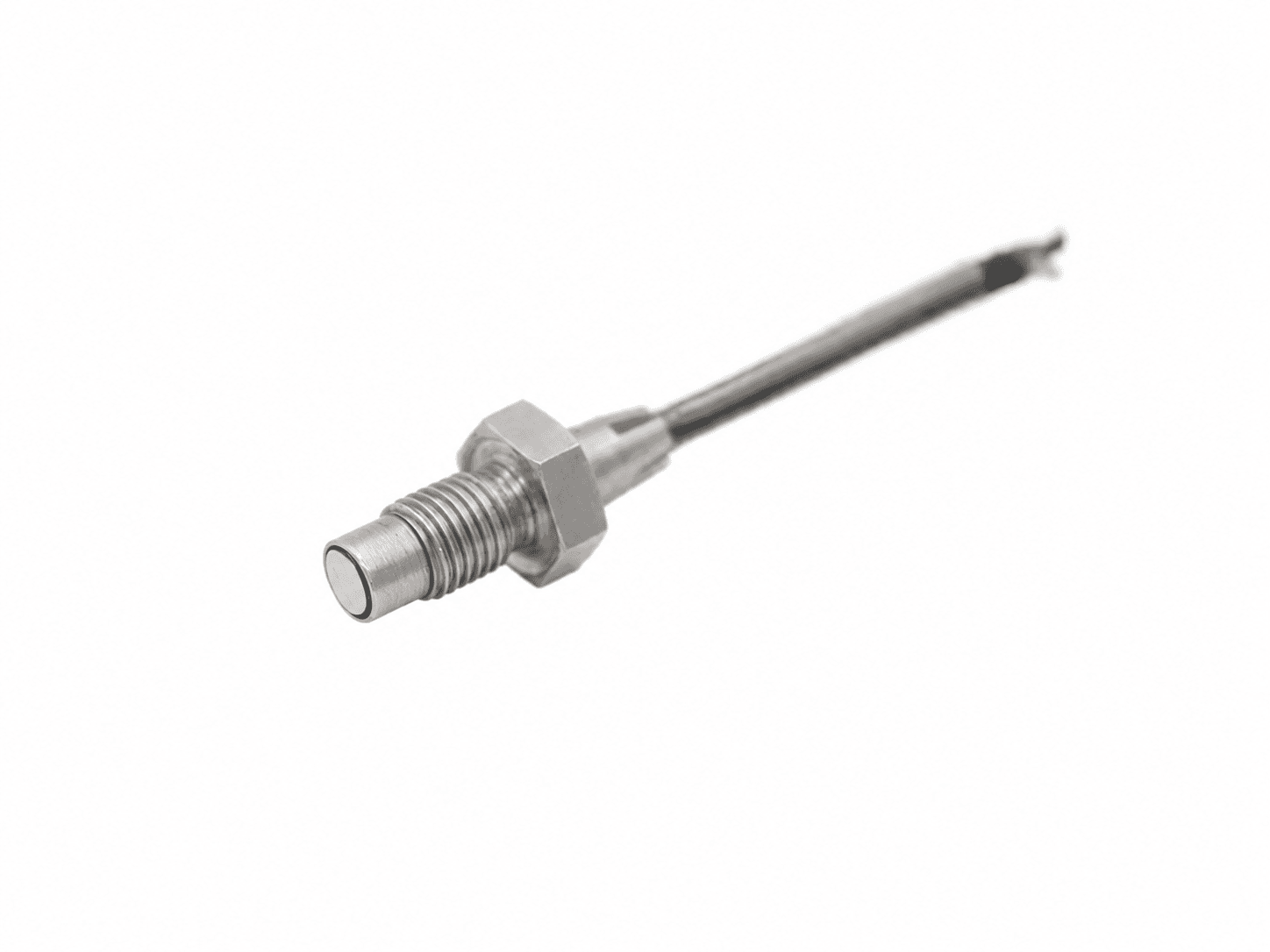
Source photographs and renderings identify the stated arrangements. Range, medium, output, installation and measured response must match the offered configuration. See each caption for its sensing principle.
SOURCE-DOCUMENTED HARDWARE REFERENCES
Review the package and its sensing principle.
These supplier-reference images show the indicated arrangements. Final pressure, medium, dimensional and response requirements are confirmed for the proposed configuration.
AT THE PRESSURE PORT
The installed passage changes the recorded event.
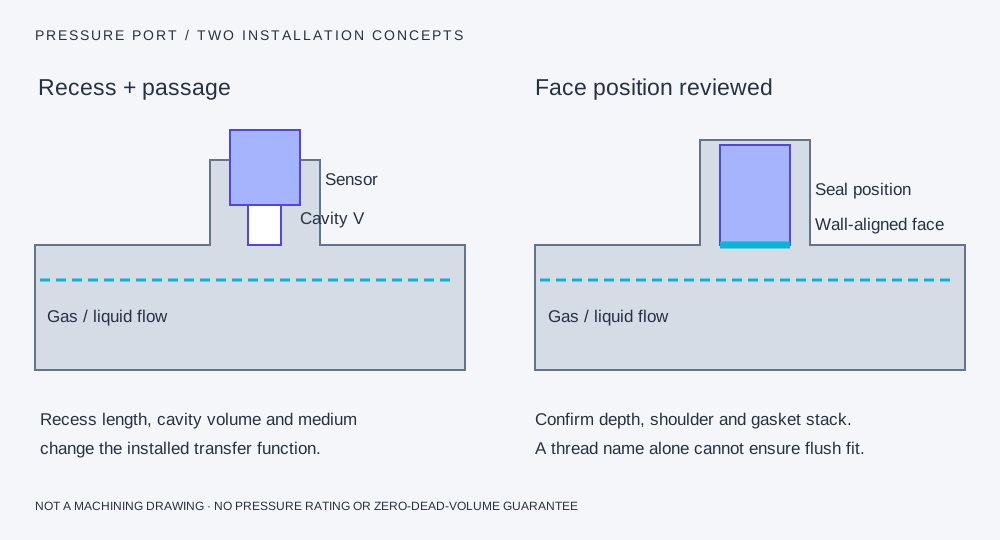
A recess adds an acoustic system.
A small cavity and connecting passage can add amplitude peaking, ringing and delay. A tapered pipe thread does not set a reproducible diaphragm depth.
Flush alignment needs dimensions.
Match the front face, sealing shoulder, gasket compression and allowed protrusion/recess. A protection layer or screen also belongs in the installed response review.
Pressure-chain questions for this configuration
Is the largest positive peak enough to select the range?
Include the steady baseline, negative phase, reference pressure and pulse repetition. Confirm measurement, proof and fatigue limits separately.
Can I use a remote pressure tap?
Only after its installed transfer function is acceptable for the event. A passage or tube may dominate the response even with a fast sensing element.
Sources and scope of the comparison
Original-model facts and general methods describe their named sources. They do not qualify a PPS unit or imply manufacturer affiliation.