REQUEST A CONFIGURATION / PPS SERIES
Select the signal and installation you need.
PPS codes below identify inquiry families. The table defines what to review; it does not assign an unverified pressure, temperature or bandwidth rating to a supplied unit.
| Configuration request | Pressure / task | Electrical chain | Installation review | Next step |
|---|---|---|---|---|
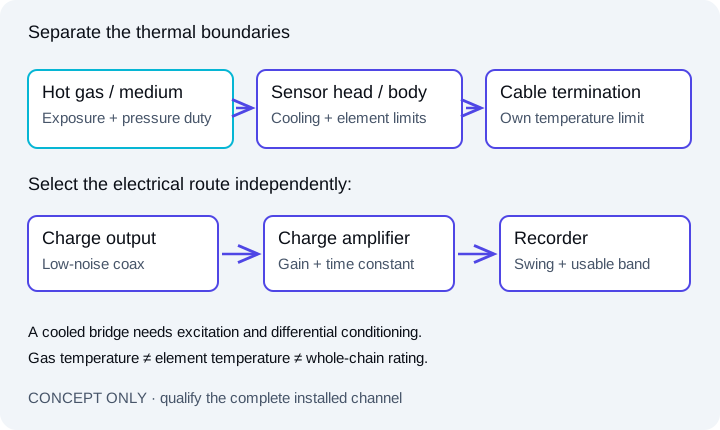
| PPS-CHG-HTCharge output for thermal exposure | Pressure range and duration supplied in the RFQ | pC/bar or pC/psi; external charge amplifier | Crystal, insulation, cable hot zone and time constantOriginal charge model + temperature duty | Request this family ↘ |
| PPS-BLT-TOAShock-front timing request | Arrival-time threshold and local pressure environment | Timing filter and acquisition interface need separate review | ToA timing purpose is distinct from calibrated full pressure waveformFull original ToA model required | Request this family ↘ |
| PPS-PRZ-WCTCooled DC + dynamic assembly | Hot-medium baseline and transient extrema | Bridge chain and thermal drift accepted for the assembly | Gas/body/element temperatures, coolant envelope and responseKulite WCTV-312(M) exact variant | Request this family ↘ |
Suggested channel tasks — configuration review, not a test procedure
| Measurement task | Candidate route | Acceptance question |
|---|---|---|
| Dynamic chamber pressure | PPS-CHG-HT + compatible charge amplifier | Required spectrum, excursion, droop and hot-zone limits? |
| Mean pressure plus fluctuations | PPS-PRZ-WCT or qualified bridge assembly | Reference pressure, installed response and cooling evidence? |
| Shock-front timing | PPS-BLT-TOA timing review | Arrival definition, channel latency and common time base? |
| Cryogenic feed-side pressure | Separately qualified low-temperature assembly | Exact fluid, materials, seals, thermal cycling and baseline? |
01 / ENGINEERING NOTES
Assign a measurand to each channel
NASA’s published RDRE work reports mean injector-face pressure and co-rotating detonations as distinct observations. That motivates a selection question: which part of the record must each channel preserve? A fluctuation channel does not automatically retain mean chamber pressure, and a timing channel does not automatically recover calibrated amplitude. The complementary-channel plan here is an engineering selection proposal, not a NASA-prescribed architecture.
02 / ENGINEERING NOTES
Keep chamber heat and cryogenic feed conditions separate
A sensor selected for a hot chamber cannot be assumed suitable for a cryogenic fluid line. Identify each medium, pressure reference, thermal exposure and installation. Material compatibility, sealing, cooldown behavior and cycling must be reviewed for the exact proposed assembly.
03 / ENGINEERING NOTES
Review the port before interpreting a peak
A recessed sensing face or long pressure passage can add resonance and delay. Supply the port drawing, thermal protection and cable route with the required amplitude/phase tolerance. Water cooling and flame protection introduce their own installation and response questions; their presence does not qualify the channel.
04 / ENGINEERING NOTES
Request a channel-by-channel quotation package
List quantity, signal principle, pressure range, temperature duty, desired conditioning, recorder input and calibration deliverables for every channel. Include the existing full model suffixes and installation drawings. A proposed channel plan remains subject to dimensional, thermal and dynamic acceptance; it is not a released propulsion qualification.
Pressure-chain questions for this configuration
Can one pressure channel provide mean pressure, sharp peaks and arrival time?
Only if its pressure reference, complete transfer response and timing are qualified for all three tasks. Separate complementary channels may be more appropriate.
Does a high-temperature sensor also cover cryogenic propellant lines?
No such compatibility follows from its high-temperature rating. The exact cold medium, materials, seals, cable and thermal cycling require separate qualification.
Sources and scope of the comparison
- PCB Piezotronics: pressure-sensing principles and installation
- NIST: dynamic pressure measurement and calibration
- Kulite WCTV-312(M): original cooled bridge-sensor datasheet
- NASA: rotating-detonation rocket-engine test observations
Original-model facts and general methods describe their named sources. They do not qualify a PPS unit or imply manufacturer affiliation.