REQUEST A CONFIGURATION / PPS SERIES
Select the signal and installation you need.
PPS codes below identify inquiry families. The table defines what to review; it does not assign an unverified pressure, temperature or bandwidth rating to a supplied unit.
| Configuration request | Pressure / task | Electrical chain | Installation review | Next step |
|---|---|---|---|---|
| PPS-PRZ-WCTCooled DC + dynamic assembly | Hot-medium baseline and transient extrema | Bridge chain and thermal drift accepted for the assembly | Gas/body/element temperatures, coolant envelope and responseKulite WCTV-312(M) exact variant | Request this family ↘ |
DOCUMENTED CONFIGURATION OPTIONS
Start with a specific range and signal interface.
These PPS codes map to the named source arrangements. Source values guide quotation review; acceptance applies to the exact offered assembly.
DC + DYNAMIC BRIDGE
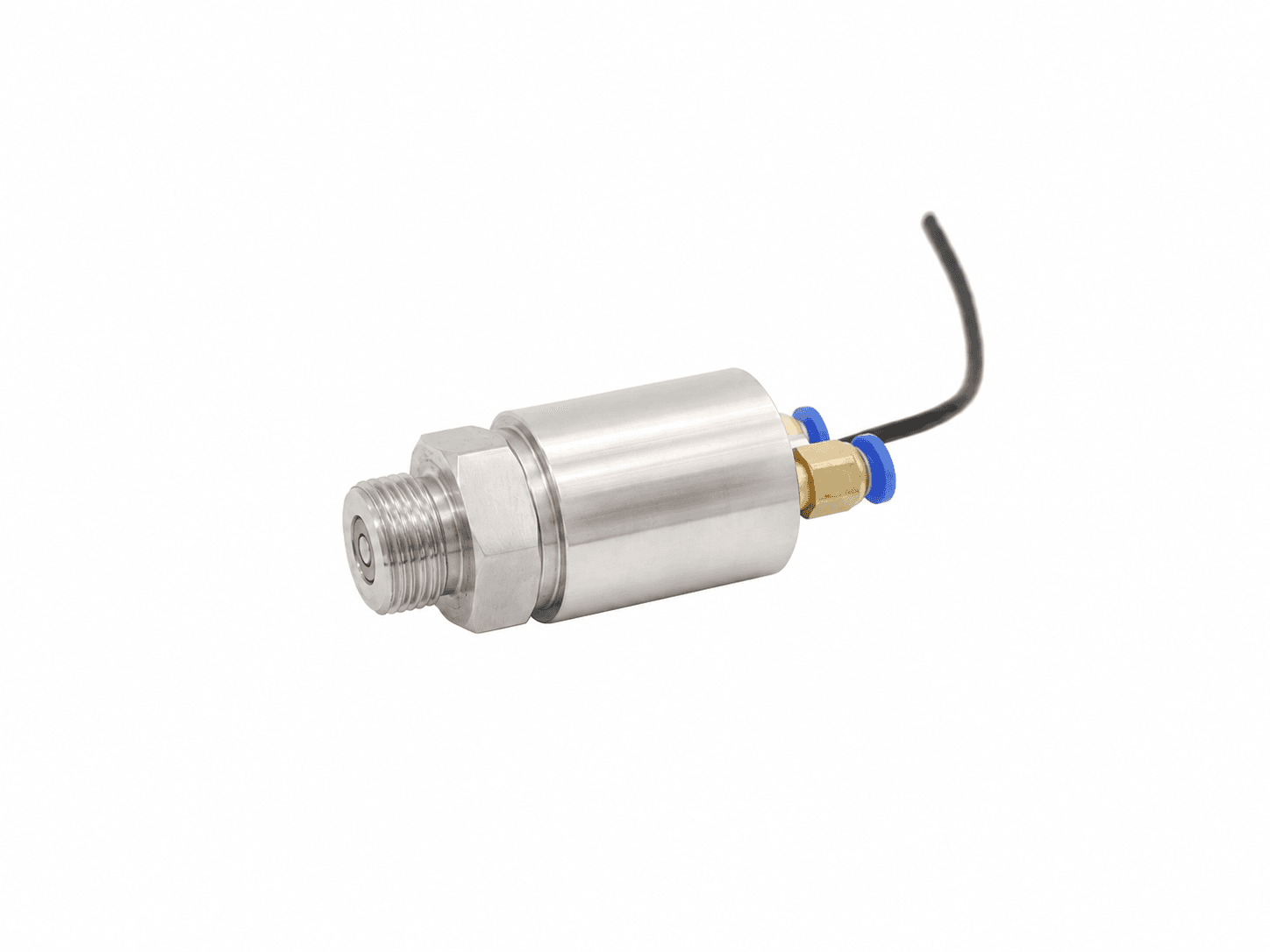
PPS-PRZ-C10
Water-cooled bridge pressure configuration
Not specified in source table; confirm gauge/absolute/reference
Source-documented configuration · quotation review required
- Output
- Differential millivolts; bridge-compatible conditioning
- Pressure reference
- Not specified in source table; confirm gauge/absolute/reference
- Source temperature
- 0 to +450 deg C with specified cooling
- Mount
- M20x1.5 source drawing
- Cooling
- Source water pressure 300-700 kPa and flow 2 L/min; inlet temperature and full duty to confirm
- Conditioning
- Differential mV sensor; separately described nominal 0-5 V amplifier
- Medium
- non-corrosive, nonconductive, compatible with silicon/stainless steel
- Excitation
- Source alternatives: 1 or 1.5 mA, or 12 VDC; exact bridge variant to confirm
Source envelopes: 1-600 kPa or 1-100 MPa; exact discrete ranges are not enumerated. Submit a custom range for review.
Exact range requires engineering review; enter your pressure requirement in the RFQ.
Review PPS-PRZ-C10 dimensions & interfaces ↗Source values & acceptance checks · PPS-PRZ-C10
Source natural-frequency envelope 200-1000 kHz is not paired to individual ranges. Rise time is described only as microsecond-level.
Confirm before a final specification
- Confirm exact pressure reference, excitation, sensitivity and pinout for the quoted assembly.
- Request usable installed response and the required calibration deliverables.
- Obtain an approved dimensional/port drawing; catalogue dimensions do not establish a drop-in fit.
- Gas/body/element temperatures differ. Source 450 deg C does not establish a 1093 deg C or uncooled rating.
This is catalogue evidence, not a serial-unit calibration certificate, stock confirmation or approved manufacturing drawing.
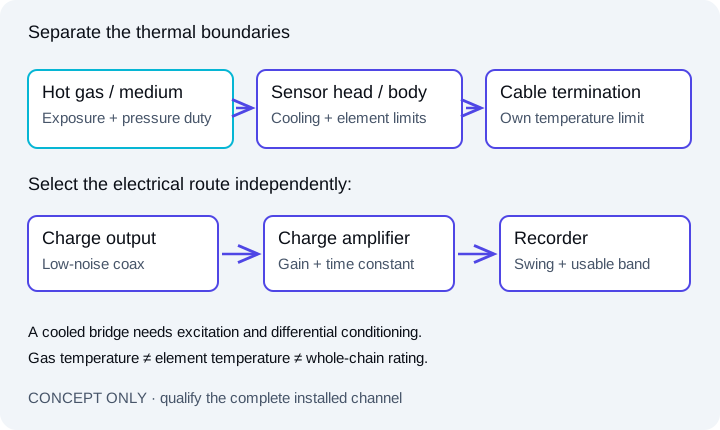
Cooled-assembly specification inputs
| Boundary | Supply | Acceptance evidence |
|---|---|---|
| Pressure side | Medium, baseline, transient extrema and duty | Wetted materials, pressure rating, seal and installed response |
| Thermal side | Gas, wall and body temperatures versus time | Cooling-dependent element limits, drift and thermal response |
| Coolant side | Fluid, inlet temperature, pressure, flow and available monitoring | Exact operating envelope, leak checks and loss-of-cooling procedure |
| Electrical side | Excitation, sensitivity, gain, cable and recorder range | DC accuracy and dynamic amplitude/phase acceptance |
01 / ENGINEERING NOTES
Specify the three temperatures
Hot gas temperature, sensor-body temperature and silicon-element temperature are not interchangeable. A cooled assembly can expose its outer structure to a hotter medium while keeping the sensing element within its operating envelope. Claims such as 1,093°C gas operation require the exact assembly and cooling conditions; they are not bare-chip temperature ratings.
02 / ENGINEERING NOTES
Use the source model within its stated limits
The CYG409 supplier reference describes a cooled high-frequency pressure arrangement with a 0–450°C medium-temperature range, M20×1.5 mounting and range-dependent natural frequency. It does not substantiate a 1,093°C PPS rating or a universal flat bandwidth. The exact coolant and operating conditions must be checked against the original source and the offered configuration.
03 / ENGINEERING NOTES
Treat cooling as part of the measurement assembly
The quotation needs coolant identity, inlet conditions, available pressure/flow and installation constraints. Review sealing, isolation from the pressure medium, thermal stabilization and the customer’s loss-of-cooling procedure. A photograph of cooling connections does not establish pressure containment or validated thermal performance.
- Identify available flow and temperature monitoring.
- Supply the mechanical drawing including sensing-face position and cooling connections.
- State required warm-up stability, drift and repeatability over the planned duty.
04 / ENGINEERING NOTES
Verify baseline accuracy and dynamic response separately
A cooled bridge may retain DC pressure, but temperature gradients, long passages and conditioning can affect the record. Define static accuracy and drift separately from dynamic amplitude/phase tolerance. The original Kulite WCTV-312(M) is a specific reference: WCT, WCTV and EWCTV designations must not be merged without matching documents.
ORIGINAL-MODEL DATA / INDEPENDENT REVIEW
Keep original specifications separate from a proposed replacement.
Facts below describe the named original models. A PPS configuration still needs its own dimensional, electrical and calibration evidence. Resonance and flat bandwidth are different quantities.
| Original model & source | Verified reference facts | Compatibility check | Review request |
|---|---|---|---|
| Kulite WCTV-312(M) | Cooled silicon bridge; nominal 100 mV full scale. Cooling conditions and exact suffix required. | Use exact WCTV versus WCT/EWCTV naming. Gas/media temperature, internal sensor temperature and cooling conditions are different. Do not copy 1093°C as the silicon-chip operating temperature. | Review this original ↘ |
No affiliation or universal interchangeability is implied. Pressure-port threads and electrical connector threads must be checked separately.
Source photographs and renderings identify the stated arrangements. Range, medium, output, installation and measured response must match the offered configuration. See each caption for its sensing principle.
SOURCE-DOCUMENTED HARDWARE REFERENCES
Review the package and its sensing principle.
These supplier-reference images show the indicated arrangements. Final pressure, medium, dimensional and response requirements are confirmed for the proposed configuration.
AT THE PRESSURE PORT
The installed passage changes the recorded event.
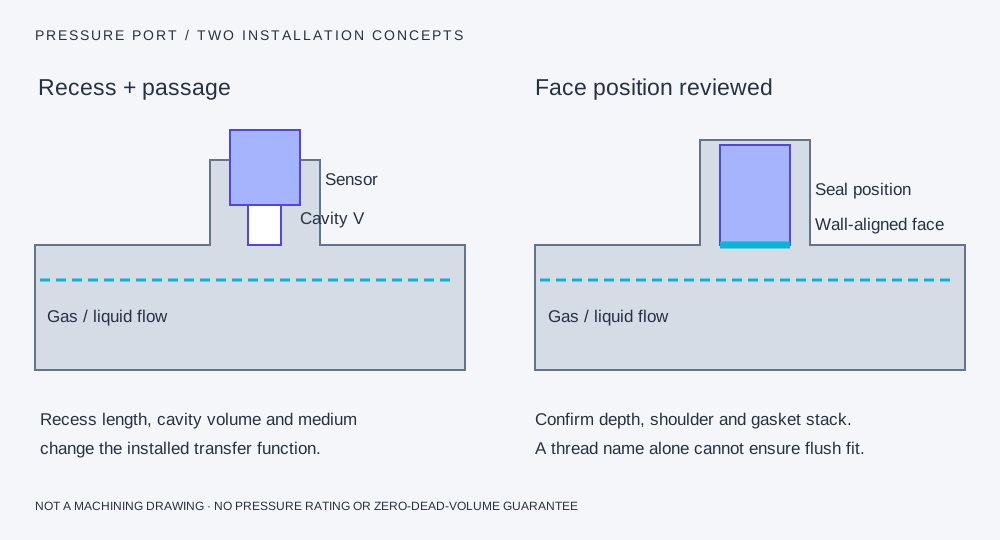
A recess adds an acoustic system.
A small cavity and connecting passage can add amplitude peaking, ringing and delay. A tapered pipe thread does not set a reproducible diaphragm depth.
Flush alignment needs dimensions.
Match the front face, sealing shoulder, gasket compression and allowed protrusion/recess. A protection layer or screen also belongs in the installed response review.
Pressure-chain questions for this configuration
Does 1,093°C gas mean the silicon element operates at 1,093°C?
No. Gas exposure, body temperature and element temperature are distinct. Any such gas-temperature capability needs a qualified assembly and stated cooling conditions.
Is a cooling connection enough to qualify the sensor?
No. The exact pressure boundary, coolant envelope, thermal duty, electrical chain and installed response need documented acceptance.
Sources and scope of the comparison
- Kulite WCTV-312(M): original cooled bridge-sensor datasheet
- CYG409 supplier source: cooled pressure configuration
- NIST: pressure-tubing amplitude and phase response
Original-model facts and general methods describe their named sources. They do not qualify a PPS unit or imply manufacturer affiliation.