REQUEST A CONFIGURATION / PPS SERIES
Select the signal and installation you need.
PPS codes below identify inquiry families. The table defines what to review; it does not assign an unverified pressure, temperature or bandwidth rating to a supplied unit.
| Configuration request | Pressure / task | Electrical chain | Installation review | Next step |
|---|---|---|---|---|
| PPS-CHG-H2CYLCylinder pressure / hydrogen request | Absolute baseline, cyclic peak and overload separately | Charge sensitivity and complete conditioning chain | Hydrogen/material review, front seal and thermal responseKistler 6052C full variant for review | Request this family ↘ |
Cylinder-pressure review before a proposed replacement
| Interface | Required information | Why it matters |
|---|---|---|
| Mechanical | Original full suffix, port drawing, thread pitch and seal shoulder | M5×0.5 and M5×0.8 are different interfaces |
| Pressure | Cyclic peak, baseline, cycle rate, measurement duration and overload | Operating range and repeated-pulse qualification are separate |
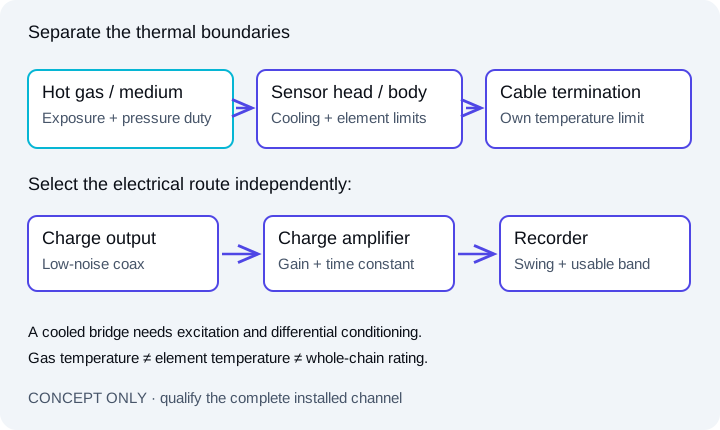
| Thermal / medium | Fuel composition, wetted materials, exposure and cooling | Hydrogen suitability and thermal error require exact assembly evidence |
| Acquisition | Charge sensitivity, amplifier settings, encoder and channel timing | Phase and pressure referencing affect the interpreted cycle |
01 / ENGINEERING NOTES
Start at the front seal
Kistler describes its original 6052C family as a front-sealing M5×0.5 piezoelectric cylinder-pressure sensor suitable for hydrogen combustion. That is a source-specific reference, not a declaration that a PPS assembly shares its fit or qualification. Compare the complete installation drawing, sensing-face position, sealing geometry and specified installation procedure.
- Provide the full original part number and available installation drawing.
- Include access, cable routing, available engagement and cooling constraints.
- Confirm the proposed dimensions before manufacturing or modifying an engine port.
02 / ENGINEERING NOTES
Separate cyclic pressure from the absolute reference
A charge chain records pressure changes with a finite time constant. Engine-cycle analysis may also require a pressure-reference method and synchronized crank-angle data. Specify the required absolute-pressure treatment, cycle-to-cycle repeatability and allowed timing error in the acquisition brief; do not infer them from sensor sensitivity alone.
03 / ENGINEERING NOTES
Hydrogen and heat need separate acceptance evidence
Fuel compatibility, pressure containment, thermal-transient error and temperature rating answer different questions. State medium composition, duty cycle, gas and sensor-body temperatures, and whether cooling is available. A water-cooled housing is a separate proposed configuration with its own leak, flow and response requirements.
- Identify wetted materials, diaphragm and seal evidence needed by your laboratory.
- State continuous and short-duration exposures separately.
- Request a documented recovery and repeatability check for the intended cycle sequence.
04 / ENGINEERING NOTES
Quote the complete cylinder-pressure channel
Include sensor, signal-compatible cable, charge amplifier, recorder range and synchronization requirements. Review electrical headroom at the cyclic peak and low-frequency droop over the useful record. The three accessory requests below are optional review items; the mounting and protection kits must be suitable for the actual cylinder installation.
ORIGINAL-MODEL DATA / INDEPENDENT REVIEW
Keep original specifications separate from a proposed replacement.
Facts below describe the named original models. A PPS configuration still needs its own dimensional, electrical and calibration evidence. Resonance and flat bandwidth are different quantities.
| Original model & source | Verified reference facts | Compatibility check | Review request |
|---|---|---|---|
| Kistler 6052C | Piezoelectric cylinder-pressure family; M5×0.5 front-sealing installation. | Do not invent pressure or maximum-temperature figures from the visible family page; use the exact datasheet for each proposed variant. | Review this original ↘ |
No affiliation or universal interchangeability is implied. Pressure-port threads and electrical connector threads must be checked separately.
AT THE PRESSURE PORT
The installed passage changes the recorded event.
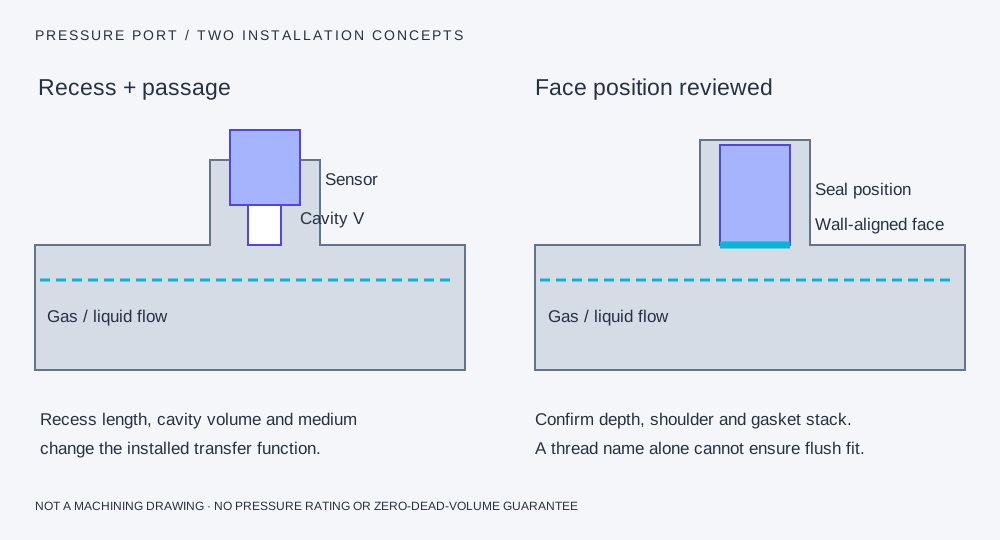
A recess adds an acoustic system.
A small cavity and connecting passage can add amplitude peaking, ringing and delay. A tapered pipe thread does not set a reproducible diaphragm depth.
Flush alignment needs dimensions.
Match the front face, sealing shoulder, gasket compression and allowed protrusion/recess. A protection layer or screen also belongs in the installed response review.
Pressure-chain questions for this configuration
Is every M5 pressure sensor compatible with a 6052C port?
No. Thread pitch, front seal, diaphragm location, engagement and installation limits need a drawing-based review. The thread diameter alone does not establish fit.
Is a hydrogen-compatible sensor automatically suitable for any hydrogen engine?
No. The exact fuel mixture, pressure cycle, thermal exposure, wetted materials and installation must be accepted for the proposed assembly.
Sources and scope of the comparison
- Kistler 6052C: original hydrogen-combustion cylinder-pressure family
- PCB Piezotronics: pressure-sensing principles and installation
Original-model facts and general methods describe their named sources. They do not qualify a PPS unit or imply manufacturer affiliation.