REQUEST A CONFIGURATION / PPS SERIES
Select the signal and installation you need.
PPS codes below identify inquiry families. The table defines what to review; it does not assign an unverified pressure, temperature or bandwidth rating to a supplied unit.
| Configuration request | Pressure / task | Electrical chain | Installation review | Next step |
|---|---|---|---|---|
| PPS-ICP-113 / PPS-ICP-102Flush dynamic piezoelectric | Dynamic excursion + static baseline, psi / bar / MPa | IEPE voltage; current, bias and headroom by configuration | Clamp/ground isolation, installed response and seal geometryPCB Piezotronics 113B / 102B | Request this family ↘ |
| PPS-CHG-HTCharge output for thermal exposure | Pressure range and duration supplied in the RFQ | pC/bar or pC/psi; external charge amplifier | Crystal, insulation, cable hot zone and time constantOriginal charge model + temperature duty | Request this family ↘ |
| PPS-PRZ-062 / PPS-PRZ-190Miniature DC + dynamic bridge | Absolute / gauge / differential reference explicitly selected | Bridge mV/V, excitation, gain and output swing | Exact thread pitch, front/reference-side response and mediumKulite XCQ / XTL; Endevco 8510B / 8530C | Request this family ↘ |
Battery-test pressure channel plan
| Location / task | Candidate route | Information needed |
|---|---|---|
| Enclosure baseline and buildup | PPS-PRZ DC-capable bridge review | Absolute/gauge reference, duration, range, temperature and drift |
| Fast vent-related pressure transient | PPS-ICP / PPS-CHG dynamic review | Peak excursion, pulse duration, hot gas/particle exposure and port geometry |
| External chamber pressure | Separate flush or free-field configuration | Measurement boundary, incident/reflected geometry and synchronization |
01 / ENGINEERING NOTES
Pressure measurement supports the test plan
DOE’s lithium-ion safety bulletin describes rapid release of flammable gases during thermal runaway. It supports the application context, not a universal enclosure pressure or required sensor bandwidth. A pressure sensor records a defined measurand at a location; it does not by itself establish a battery safety result, test-standard compliance or explosion-protection certification.
02 / ENGINEERING NOTES
Capture buildup and the transient with suitable low-frequency response
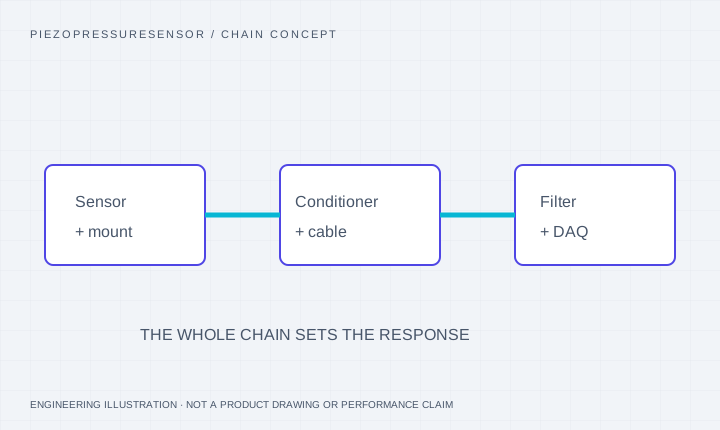
A slowly changing enclosure baseline and a brief pressure peak place different demands on the chain. A bridge can retain DC; a piezoelectric channel needs an adequate time constant for the useful record. Specify the expected duration, negative excursion and overload recovery so a long plateau is not mistaken for sensor drift or decay.
03 / ENGINEERING NOTES
Protect against heat and contamination with a reviewed assembly
Hot gases, condensate and particles can affect a sensing face, seal or pressure passage. Provide medium and temperature information available from the test plan. A remote tube or protective screen may reduce exposure but can alter the waveform; review the installed response rather than assuming protection is acoustically transparent.
04 / ENGINEERING NOTES
Synchronize pressure with the laboratory record
If pressure is compared with temperature, electrical or imaging channels, state the common trigger, timing reference and acceptable skew. Include sensor locations and cable routes in the private attachment. Request pre/post-exposure checks where calibration stability over the test sequence matters.
Pressure-chain questions for this configuration
Does a pressure sensor establish battery test compliance?
No. The laboratory’s method, measurement scope and complete acceptance process determine compliance. A pressure channel supplies only its defined measurement.
Can a protected remote tube preserve a fast vent transient?
Only when the installed passage and protection have an acceptable transfer response for the required pulse. Their thermal benefit does not prove waveform fidelity.
Sources and scope of the comparison
- PCB Piezotronics: pressure-sensing principles and installation
- NIST: pressure-tubing amplitude and phase response
- DOE OES 2025-02: lithium-ion thermal-runaway gas-release context
- PTB research: thermal-shock effects in explosion-pressure measurement
Original-model facts and general methods describe their named sources. They do not qualify a PPS unit or imply manufacturer affiliation.