REQUEST A CONFIGURATION / PPS SERIES
Select the signal and installation you need.
PPS codes below identify inquiry families. The table defines what to review; it does not assign an unverified pressure, temperature or bandwidth rating to a supplied unit.
| Configuration request | Pressure / task | Electrical chain | Installation review | Next step |
|---|---|---|---|---|
| PPS-BLT-TOAShock-front timing request | Arrival-time threshold and local pressure environment | Timing filter and acquisition interface need separate review | ToA timing purpose is distinct from calibrated full pressure waveformFull original ToA model required | Request this family ↘ |
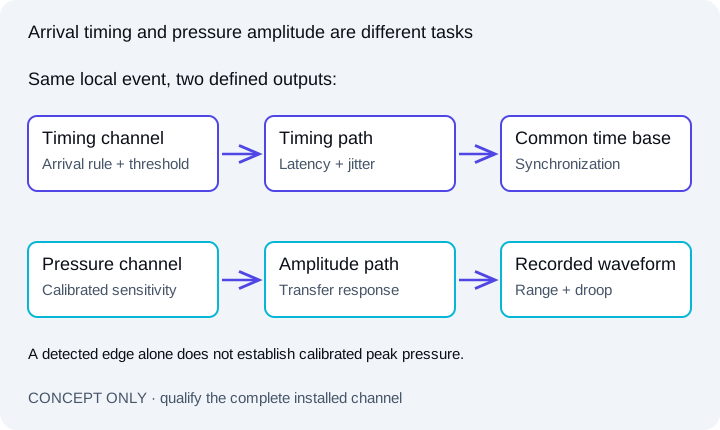
Two measurement tasks, different acceptance criteria
| Task | Specify | Verify |
|---|---|---|
| Time of arrival | Arrival definition, threshold, allowed timing error and repetition | Channel latency, jitter, threshold sensitivity and synchronization |
| Pressure waveform | Range, incident/reflected geometry, pulse duration and response tolerance | Calibrated sensitivity, installed transfer response, droop and overload recovery |
| Paired measurement | Common trigger, sensor position and channel skew | Measured timing alignment and amplitude response for each channel |
01 / ENGINEERING NOTES
Write an arrival definition before quoting rise time
First departure from baseline, a fixed threshold and a percentage of peak are different arrival definitions. Noise, filtering and amplitude changes can shift a threshold crossing. Specify the timing rule, bandwidth and permitted uncertainty rather than treating a sub-microsecond sensor label as the complete timing budget.
02 / ENGINEERING NOTES
A ToA-focused original illustrates the low-frequency trade-off
PCB Piezotronics lists the original 132B38 with an incident rise time ≤3 μs and reflected rise time ≤0.5 μs, alongside an 11 kHz low-frequency −5% point. That combination supports a timing-focused comparison; it does not imply a retained DC baseline or an undistorted long pressure pulse. Those figures belong to the named original model and do not rate a PPS-BLT-TOA unit.
03 / ENGINEERING NOTES
Account for location and channel delay
A timing comparison depends on the surveyed sensing locations and the latency of each electrical path. Cable propagation, conditioning, trigger logic, filters and recorder synchronization belong in the uncertainty review. A nominal sampling interval is not a complete arrival-time uncertainty.
- Supply the sensing-face locations and spacing uncertainty.
- State the acquisition timing reference and allowed interchannel skew.
- Record the exact filter and threshold settings with the measurement.
04 / ENGINEERING NOTES
Incident and reflected response must stay distinct
A flush wall sensor and a free-field pencil probe encounter different loading. The PCB Piezotronics 137B23B original specifies an incident rise time of at most 6.5 μs; its resonance figure must not be substituted for this timing value. A quoted reflected rise time for another sensor does not establish the pencil probe’s incident performance.
05 / ENGINEERING NOTES
Use a second channel when amplitude also matters
For a full pressure history, review calibrated range, overshoot, droop, low-frequency response and the installed geometry as well as timing. Supply the exact original ToA model if replacing an existing channel. A PPS-BLT-TOA inquiry identifies a review task, not a released nanosecond specification.
ORIGINAL-MODEL DATA / INDEPENDENT REVIEW
Keep original specifications separate from a proposed replacement.
Facts below describe the named original models. A PPS configuration still needs its own dimensional, electrical and calibration evidence. Resonance and flat bandwidth are different quantities.
| Original model & source | Verified reference facts | Compatibility check | Review request |
|---|---|---|---|
| PCB Piezotronics 113B22 | 5,000 psi / 344.7 bar; 1 mV/psi; resonance ≥500 kHz; rise time ≤1 μs. | The range is for ±5 V output. Resonance is not flat bandwidth. Mounting uses a separate floating clamp nut; electrical 10-32 is not a pressure-port thread. | Review this original ↘ |
| PCB Piezotronics 137B23B | 50 psi / 3.447 bar; 100 mV/psi; incident rise time ≤6.5 μs; BNC. | Incident rise time is 6.5 µs, not the ≤1 µs reflected response of 113B/102B. No general sub-microsecond claim is justified across blast families. | Review this original ↘ |
No affiliation or universal interchangeability is implied. Pressure-port threads and electrical connector threads must be checked separately.
AT THE PRESSURE PORT
The installed passage changes the recorded event.
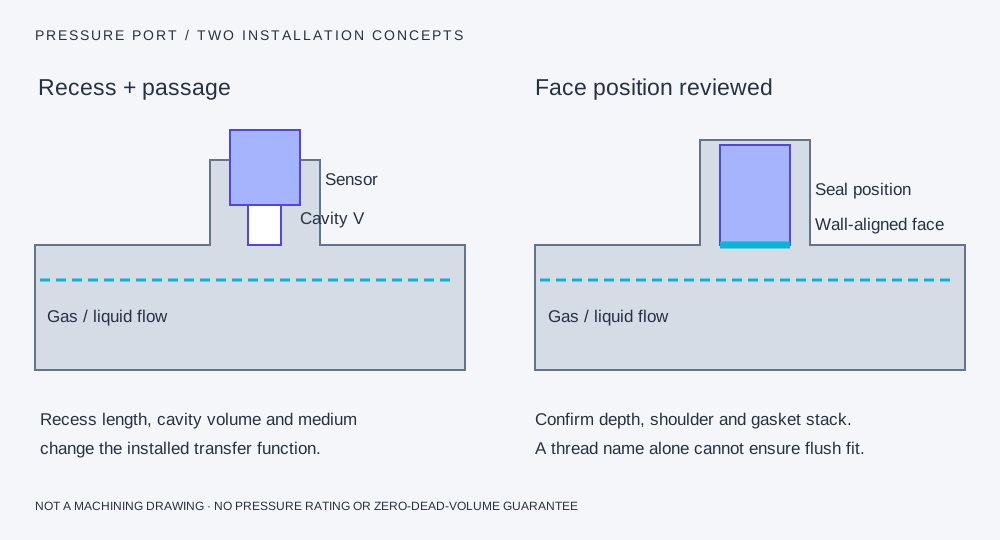
A recess adds an acoustic system.
A small cavity and connecting passage can add amplitude peaking, ringing and delay. A tapered pipe thread does not set a reproducible diaphragm depth.
Flush alignment needs dimensions.
Match the front face, sealing shoulder, gasket compression and allowed protrusion/recess. A protection layer or screen also belongs in the installed response review.
Pressure-chain questions for this configuration
Does a fast timing pulse provide calibrated peak pressure?
Not by itself. Amplitude measurement needs a separately established sensitivity, range, installed response and uncertainty for the pressure channel.
Can sampling interval alone define arrival-time accuracy?
No. Location uncertainty, threshold choice, noise, filtering, latency, jitter and interchannel synchronization also contribute.
Sources and scope of the comparison
- NIST: dynamic pressure measurement and calibration
- PCB Piezotronics 137B23B: original incident-response specification
- PCB Piezotronics 132B38: original ToA-focused response
Original-model facts and general methods describe their named sources. They do not qualify a PPS unit or imply manufacturer affiliation.