REQUEST A CONFIGURATION / PPS SERIES
Select the signal and installation you need.
PPS codes below identify inquiry families. The table defines what to review; it does not assign an unverified pressure, temperature or bandwidth rating to a supplied unit.
| Configuration request | Pressure / task | Electrical chain | Installation review | Next step |
|---|---|---|---|---|
| PPS-CHG-HTCharge output for thermal exposure | Pressure range and duration supplied in the RFQ | pC/bar or pC/psi; external charge amplifier | Crystal, insulation, cable hot zone and time constantOriginal charge model + temperature duty | Request this family ↘ |
| PPS-CHG-H2CYLCylinder pressure / hydrogen request | Absolute baseline, cyclic peak and overload separately | Charge sensitivity and complete conditioning chain | Hydrogen/material review, front seal and thermal responseKistler 6052C full variant for review | Request this family ↘ |
| PPS-PRZ-WCTCooled DC + dynamic assembly | Hot-medium baseline and transient extrema | Bridge chain and thermal drift accepted for the assembly | Gas/body/element temperatures, coolant envelope and responseKulite WCTV-312(M) exact variant | Request this family ↘ |
Combustion pressure channel plan
| Task | Candidate route | Decision to resolve |
|---|---|---|
| Hydrogen-engine cyclic cylinder pressure | PPS-CHG-H2CYL + charge amplifier | Front seal, thermal error, cycle timing and pressure referencing |
| Combustor pressure fluctuation | PPS-CHG-HT or qualified IEPE assembly | Lowest frequency, peak excursion, noise and thermal duty |
| Static baseline in a hot-medium installation | PPS-PRZ-WCT cooled bridge review | Cooling, reference pressure, drift and installed response |
| Remote protected pressure tap | Separately reviewed passage assembly | Thermal benefit versus amplitude/phase distortion |
01 / ENGINEERING NOTES
Keep the cylinder and combustor briefs separate
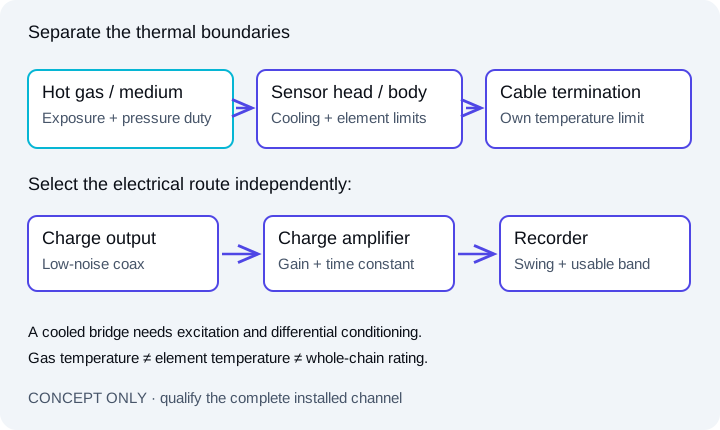
A cyclic engine pressure waveform, a small thermoacoustic fluctuation and a continuous baseline need different low-frequency and thermal behavior. Identify the installation and useful record before choosing the sensing principle. A piezoelectric fluctuation channel cannot be assumed to retain the steady baseline indefinitely.
02 / ENGINEERING NOTES
Review hydrogen compatibility independently of response
The original Kistler 6052C family lists suitability for hydrogen combustion. That fact does not qualify another sensor or the rest of its installation. Provide the exact mixture, wetted materials, pressure duty, seals and thermal exposure for the proposed assembly’s acceptance review.
03 / ENGINEERING NOTES
Avoid exchanging thermal error for hidden acoustic error
Cooling, protective coatings or remote passages can change the installed transfer response. A cooled body can keep the sensing element within a lower temperature envelope, while a remote tube can introduce resonance and delay. Ask for thermal behavior and dynamic response under the intended mounting conditions.
04 / ENGINEERING NOTES
Specify the whole signal path and acceptance package
For charge mode include insulation, low-noise cable, sensitivity and amplifier time constant. For IEPE include current, compliance and cable drive. For a bridge include excitation, sensitivity, common-mode range and gain. Add required pressure calibration, dynamic-response evidence, uncertainty and serial-number traceability to the quotation brief.
Pressure-chain questions for this configuration
Can one hydrogen-rated cylinder sensor replace any turbine pressure channel?
No. Port geometry, mean pressure, fluctuation level, thermal duty, conditioning and required response need a separate comparison for each installation.
Does a thermal shield leave the pressure waveform unchanged?
That must be verified for the exact protection and installation. Thermal protection can alter amplitude, phase and rise time.
Sources and scope of the comparison
- Kistler 6052C: original hydrogen-combustion cylinder-pressure family
- PCB Piezotronics: pressure-sensing principles and installation
- Kulite WCTV-312(M): original cooled bridge-sensor datasheet
- NIST: pressure-tubing amplitude and phase response
Original-model facts and general methods describe their named sources. They do not qualify a PPS unit or imply manufacturer affiliation.